

One Mushroom, Endless Possibilities: How to Teach Multiple Subjects Through One Discovery 🍄🌿
Home education doesn't have to mean separate lessons, endless worksheets or recreating a classroom at your kitchen table. Sometimes, one unexpected discovery can open the door to an entire world of learning.
What if one mushroom could teach your child science, maths, English, history and more?
It sounds a little ambitious, doesn't it?
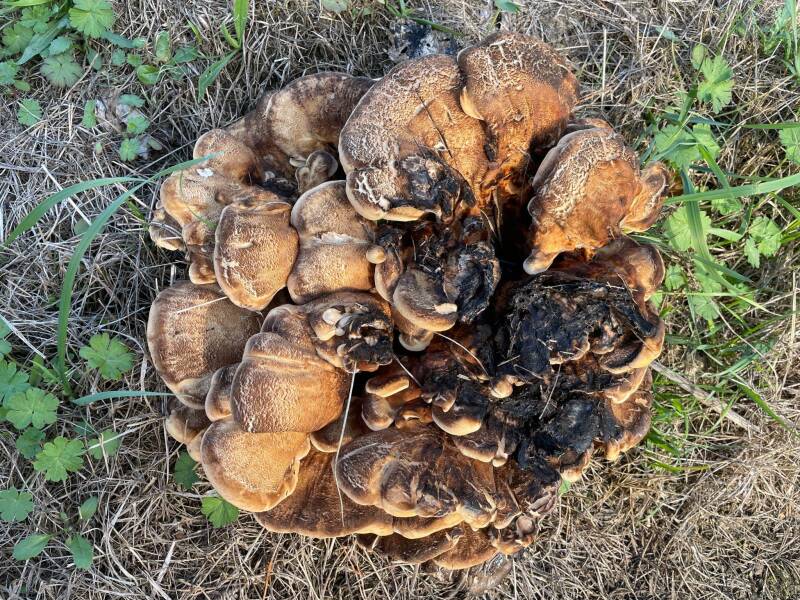
But that's exactly what happened when we were out foraging and came across a rather spectacular mushroom.
It was enormous, unusual and fascinating to look at. Naturally, we wanted to know more.
What was it called? Was it edible? Why did parts of it turn black when damaged? What caused that reaction? Could people cook with it? Had people used this type of mushroom throughout history?
One question led to another.
And before we knew it, we'd wandered through science, history, food safety, biology, chemistry and plenty of other subjects.
All because we'd stopped to investigate one mushroom.
And that is one of the most beautiful things about home education.
You don't always need to start with a subject. Sometimes, you can start with curiosity.
🌱 Learning doesn't happen in separate boxes
Think about how we traditionally divide education.
Maths happens during maths lessons. English happens during English lessons. Science happens during science lessons.
But the real world doesn't work like that.
When a scientist investigates a mushroom, they might use mathematics to measure its growth, technology to analyse its structure, geography to understand its habitat and written communication to share their findings.
Those subjects naturally overlap.
This is sometimes called cross-curricular learning or interdisciplinary learning, where one topic connects several areas of education.
And it's something home education can embrace beautifully.
Instead of asking, "What subject should we do today?", we can sometimes ask:
"What can we discover about this?"
Let's use our mushroom as an example.
🔬 1. Science: What's actually happening?
Our first questions were about the mushroom itself.
We noticed that parts of it appeared to turn darker when damaged.
Why?
Some fungi contain compounds that undergo chemical changes when their tissues are damaged and exposed to oxygen. In blackening polypores, for example, bruised areas can gradually darken.
Already, we're exploring chemistry!
But we can go much further.
Questions to explore together:
-
What exactly is a fungus?
-
Is a mushroom a plant?
-
Why don't mushrooms photosynthesise?
-
How do fungi reproduce?
-
What are spores?
-
Why do some mushrooms grow on trees or dead wood?
-
What role do fungi play in decomposition?
-
How do fungi interact with other organisms?
You could explore the differences between fungi, plants and animals, or investigate the underground networks of fungal threads called mycelium.
For younger children, this might simply involve looking at pictures, discussing what fungi need to grow and drawing their life cycle.
Older children could investigate fungal classification, cellular biology, enzymes or decomposition.
One mushroom has now introduced biology, chemistry and ecology.
Try this activity
Find photographs of three different mushrooms and compare their shapes, colours, habitats and visible features.
Ask your child to predict why they might look different.
Then research their ideas together.
The goal isn't just remembering facts. It's learning to observe, question, predict and investigate.
🔢 2. Maths: Yes, even mushrooms involve numbers!
Maths is often one of the subjects parents worry about when home educating.
But mathematical thinking is everywhere.
Imagine discovering ten mushrooms growing in a small patch of woodland.
You could count them, measure their sizes, compare them or estimate how many might grow across a larger area.
Suddenly, you've got a practical maths lesson.
For younger learners:
-
Count mushrooms in photographs.
-
Sort them by size.
-
Compare which is larger or smaller.
-
Measure mushroom caps using a ruler.
-
Create simple addition and subtraction problems.
For older learners:
-
Calculate the area of a mushroom cap, approximating it as a circle.
-
Estimate mushroom density within a measured area.
-
Explore percentages and ratios.
-
Create graphs showing different mushroom species.
-
Investigate how environmental conditions might affect growth.
Try this activity: The mushroom population challenge
Imagine you find 8 mushrooms growing in a 2 m² area.
How many might you estimate in a similar 10 m² area?
If the mushrooms were evenly distributed, your estimate would be 40.
But here's where it gets interesting.
Would that estimate actually be reliable?
Probably not without more observations!
Mushrooms don't necessarily grow evenly. Soil, moisture, shade, temperature and available nutrients can all affect where they appear.
Now you're not just practising multiplication.
You're exploring sampling, estimation, uncertainty and the limitations of mathematical models.
And that's a fantastic introduction to scientific reasoning.
📖 3. English: Reading, writing and communicating discoveries
English doesn't have to begin with a worksheet.
Sometimes it begins with a question your child genuinely wants answered.
When researching our mushroom, we needed to read information, understand unfamiliar vocabulary and discuss what we'd discovered.
That's literacy in action.
Ways to develop English skills:
-
Write a description of the mushroom.
-
Create a fact file.
-
Learn new vocabulary such as mycelium, spores, decomposition and organism.
-
Read different sources and compare their explanations.
-
Write a short story about a mushroom growing in an enchanted forest.
-
Create a persuasive argument about protecting woodland habitats.
-
Present research verbally to family members.
Adapt it to your child
Not every child enjoys writing, and that's absolutely fine.
A child who struggles with handwriting might enjoy recording a video, creating a slideshow, dictating their findings or discussing them aloud.
Those approaches can develop communication, vocabulary and reasoning, although it's still worth providing appropriate opportunities to practise writing itself.
The aim is to make learning accessible without losing sight of the skills we're trying to develop.
🌍 4. Geography: Where in the world do mushrooms grow?
Our mushroom was growing in a particular environment.
But would we find the same species in a desert? A tropical rainforest? A cold northern forest?
Why might fungi thrive in some places but not others?
Now we've moved into geography.
Questions to investigate:
-
Which countries have similar fungi?
-
What climates support mushroom growth?
-
How do rainfall and temperature affect habitats?
-
What is the difference between a woodland and a rainforest?
-
How does deforestation affect fungal communities?
-
Why are some species more common in certain regions?
Try this activity
Choose a mushroom species and research its geographical distribution.
Mark the countries or regions where it's recorded on a map.
Then compare their climates and habitats.
For older children, investigate how changing environmental conditions might affect its future distribution.
You've now combined geography, science, map reading and research.
📜 5. History: Mushrooms have a history too!
Humans have interacted with fungi for thousands of years.
Different cultures have used various fungi as food, for traditional practices, as materials and in medicine.
Some have been valued as delicacies. Others have been feared because of their toxicity.
And some have played important roles in technological and scientific discoveries.
For example, the antibiotic penicillin was developed following research into a mould belonging to the genus Penicillium.
It's not the same type of fungus as our woodland mushroom, but it's a wonderful opportunity to explore the wider fungal kingdom.
Questions to explore:
-
How did people identify edible fungi before modern field guides?
-
Which cultures have traditions involving mushroom gathering?
-
How did people preserve food before refrigeration?
-
How did the discovery of penicillin change medicine?
-
How has scientific understanding of fungi changed over time?
Try this activity
Create a timeline of important events involving fungi.
You could include traditional food uses, early scientific classification, the discovery of penicillin and modern research into fungal ecosystems.
One mushroom has now led you into social history, medical history and the history of science.
🕯️ 6. Religion, beliefs, folklore and culture
This is an area people might not immediately associate with a woodland mushroom.
Yet fungi appear in folklore, traditional beliefs, artwork and cultural practices around the world.
Some mushrooms have been associated with fairy rings, woodland spirits and supernatural stories.
Certain fungi have also held ceremonial or spiritual significance in particular cultures.
These subjects can provide opportunities to explore different worldviews respectfully.
Questions to consider:
-
Why did people historically associate fairy rings with supernatural activity?
-
How did different cultures explain unusual natural phenomena?
-
What is the difference between a scientific explanation and a traditional belief?
-
Why is folklore important to cultural identity?
-
How do stories and beliefs change as scientific knowledge develops?
This isn't about telling children what they should believe.
It's about helping them understand that humans have interpreted the natural world in different ways throughout history.
And it creates a lovely opportunity to discuss evidence, culture, belief and respectful disagreement.
🍳 7. Cooking, nutrition and life skills
One of our questions was whether the mushroom could be eaten.
And that opened another enormous learning opportunity.
Important: Never rely on photographs, an app or AI alone to identify a wild mushroom as edible. Some poisonous fungi resemble edible species, and cooking does not reliably make poisonous mushrooms safe. Children should never taste unidentified wild fungi.
But we can still explore mushroom cookery safely using shop-bought edible mushrooms.
Possible activities:
-
Compare different culinary mushroom varieties.
-
Investigate how mushrooms are grown commercially.
-
Follow a mushroom-based recipe.
-
Weigh ingredients.
-
Practise kitchen hygiene.
-
Calculate the cost of a meal.
-
Compare nutritional information.
-
Explore traditional mushroom dishes from different countries.
A simple cooking activity could involve maths, reading comprehension, science, food safety, budgeting and independence.
And afterwards, you've got lunch! 🤣
💻 8. IT skills: Researching without believing everything you read
This is one of my favourite opportunities.
When we discover something unfamiliar, we naturally want to look it up.
But finding information isn't the same as understanding whether it's reliable.
The internet contains brilliant educational resources, alongside incorrect information, misleading photographs and confidently written nonsense.
Even AI can make mistakes.
So let's teach children how to investigate properly.
Ask questions such as:
-
Who wrote this information?
-
Are they qualified or experienced in the subject?
-
Does another reliable source agree?
-
Is the photograph definitely showing the same species?
-
Is this a scientific fact, an opinion or a traditional belief?
-
What evidence supports the claim?
-
Could the information be outdated?
Try this activity: Become a fact-checker
Find two or three sources discussing the same mushroom.
Compare what they say.
Do they agree about its habitat, appearance and behaviour?
If not, why might that be?
Perhaps one source is discussing a different species. Perhaps the information is incomplete.
This teaches children something incredibly valuable:
Don't just learn what someone says. Learn how to investigate whether it's true.
🎨 9. Art, creativity and observation
Of course, we don't need to turn every discovery into formal academic work.
Sometimes the mushroom itself is enough inspiration.
Your child could photograph it, sketch it, paint it, make a clay model or design an imaginary species.
You could explore symmetry, texture, colour, pattern and shape.
Or create a fictional woodland ecosystem and decide what role different organisms play within it.
Creativity isn't separate from learning.
It encourages observation, problem-solving, experimentation and expression.
And it can be a wonderful way for children to process what they've discovered.
🧠 10. Critical thinking: The most important lesson might be the questions
Here's something I feel particularly strongly about.
Education shouldn't only be about collecting answers.
It should also teach children to question, reason and recognise when they don't know something.
Let's return to our mushroom.
We noticed it darkening.
But did we actually know why?
Was it definitely the species we thought it was?
Could another fungus look similar?
Did the darkening prove its identity?
No. One characteristic alone isn't enough to identify a mushroom reliably.
And that's where some of the most valuable learning happens.
We can make an observation, form a hypothesis, research it, compare evidence and change our understanding when necessary.
That's not failing to know the answer.
That's learning how knowledge works.
❤️ But do we really need to cover every subject?
Absolutely not!
And this is something I want to emphasise, especially for parents who are new to home education.
The point isn't to turn every walk into ten lessons.
You don't need to come home with a completed worksheet, a science experiment, a written report and a maths assessment.
Sometimes your child might ask one question, learn one interesting fact and move on.
That's fine.
Other times, a discovery might spark an interest that lasts for days or weeks.
The important thing is recognising opportunities without feeling pressured to use every single one.
Children benefit from free exploration, play and simply enjoying nature too.
And while cross-curricular learning can be incredibly effective, it doesn't mean every skill will develop automatically. Some areas, particularly foundational maths, reading and writing, may still need explicit teaching and regular practice.
Child-led learning and structured teaching can work beautifully together.
They don't have to compete.
🌿 A practical guide: How to turn one discovery into a learning adventure
You don't need to be a teacher or an expert in mushrooms to try this approach.
Here's a simple method you can use with almost anything your child discovers.
Step 1: Notice what catches their attention
It might be a mushroom, a feather, an insect, a strange rock, a broken machine or even something they see on television.
Start with their curiosity.
Step 2: Ask open-ended questions
Instead of immediately giving an explanation, try asking:
-
What do you notice?
-
What do you think it is?
-
Why do you think that happens?
-
How could we find out?
-
What would you like to know about it?
Give them time to think and form their own ideas.
Step 3: Follow the questions
If your child wants to know why mushrooms turn black, investigate that.
If they become fascinated by poisonous species, explore toxicology and safety.
If they start asking about mushroom recipes, investigate cooking and food cultures.
You don't need to force every subject into the conversation.
Step 4: Look for natural connections
Once you've explored their original question, consider whether another subject fits naturally.
Could you measure something? Map it? Write about it? Investigate its history?
Offer an opportunity rather than making every connection compulsory.
Step 5: Adapt to their learning needs
One child might enjoy writing a report.
Another might prefer discussing it, building a model, creating a presentation or doing a practical activity.
You can also adapt the depth of the research for different ages.
A younger child might count mushrooms while an older sibling calculates population estimates.
Same discovery. Different learning opportunities.
Step 6: Record what you've explored
For home education records, you could note:
Activity: Woodland foraging walk and mushroom investigation.
Learning explored: Fungal biology, chemical changes, identification safety, history, geography, mathematical estimation, research and critical thinking.
Skills practised: Observation, questioning, communication, research, reasoning and problem-solving.
You could add photographs, your child's questions, drawings or examples of their work.
You don't need an enormous written report to demonstrate that meaningful learning took place.
🍄 It doesn't have to be a mushroom!
That's the exciting part.
This approach works with almost anything.
A fallen leaf can lead to biology, seasonal changes, climate, art and measurement.
A puddle can introduce the water cycle, weather, evaporation, geography and volume.
A motorbike can lead to engineering, forces, mechanics, mathematics, design, history and business.
A fox can introduce habitats, food chains, animal behaviour, folklore, geography and environmental conservation.
A visit to the supermarket can involve budgeting, nutrition, percentages, reading labels, economics and decision-making.
The world is full of starting points.
You just need to recognise them.
🌎 Why this approach means so much to me
Through Guinea Gourmet Treats, I spend a lot of time exploring plants, forage, nutrition and the natural world.
That work overlaps beautifully with home educating my children.
A plant isn't just an ingredient. It's part of an ecosystem, with a history, a biological structure, a geographical distribution and relationships with other living things.
Understanding those connections helps me in my work, and sharing the discoveries with my children opens up even more opportunities.
I'm not standing in front of them pretending to know everything.
I'm learning alongside them.
Sometimes they ask questions I wouldn't have thought to ask.
Sometimes we discover that something we believed wasn't quite right.
And sometimes one simple discovery sends us down a rabbit hole we never expected.
That's part of what I love about education.
Curiosity doesn't follow a timetable, and learning doesn't have to stay inside a subject box.
A final thought for home educating families ❤️
If you're home educating and worrying that you haven't covered enough subjects today, consider looking at what you've actually explored together.
Did your child ask a question?
Did they investigate something unfamiliar?
Did they practise a skill, solve a problem, explain an idea or discover something new?
Those moments matter.
Of course, it's important to keep an eye on their wider educational progress and make sure they're developing the knowledge and skills they need.
But don't overlook the learning happening in ordinary life simply because it doesn't look like a traditional lesson.
Sometimes education is structured and planned.
Sometimes it's messy, unexpected and full of questions.
And sometimes...
It's one enormous mushroom growing amongst the leaves. 🍄🌿
From Sideways and Unboxed — exploring education from a different angle, one curiosity at a time.
I'd love to know: What's the most unexpected thing that has turned into a learning opportunity for your children?
#HomeEducationUK #SidewaysAndUnboxed #ChildLedLearning #CrossCurricularLearning #LearningThroughNature #HomeEdSupport #OutdoorLearning #RealWorldEducation #HomeEdIdeas #CuriosityLedLearning #GuineaGourmetTreats
Add comment
Comments