

🌹 Why Does a Rose Hip Itch? – Plants Fight Back!
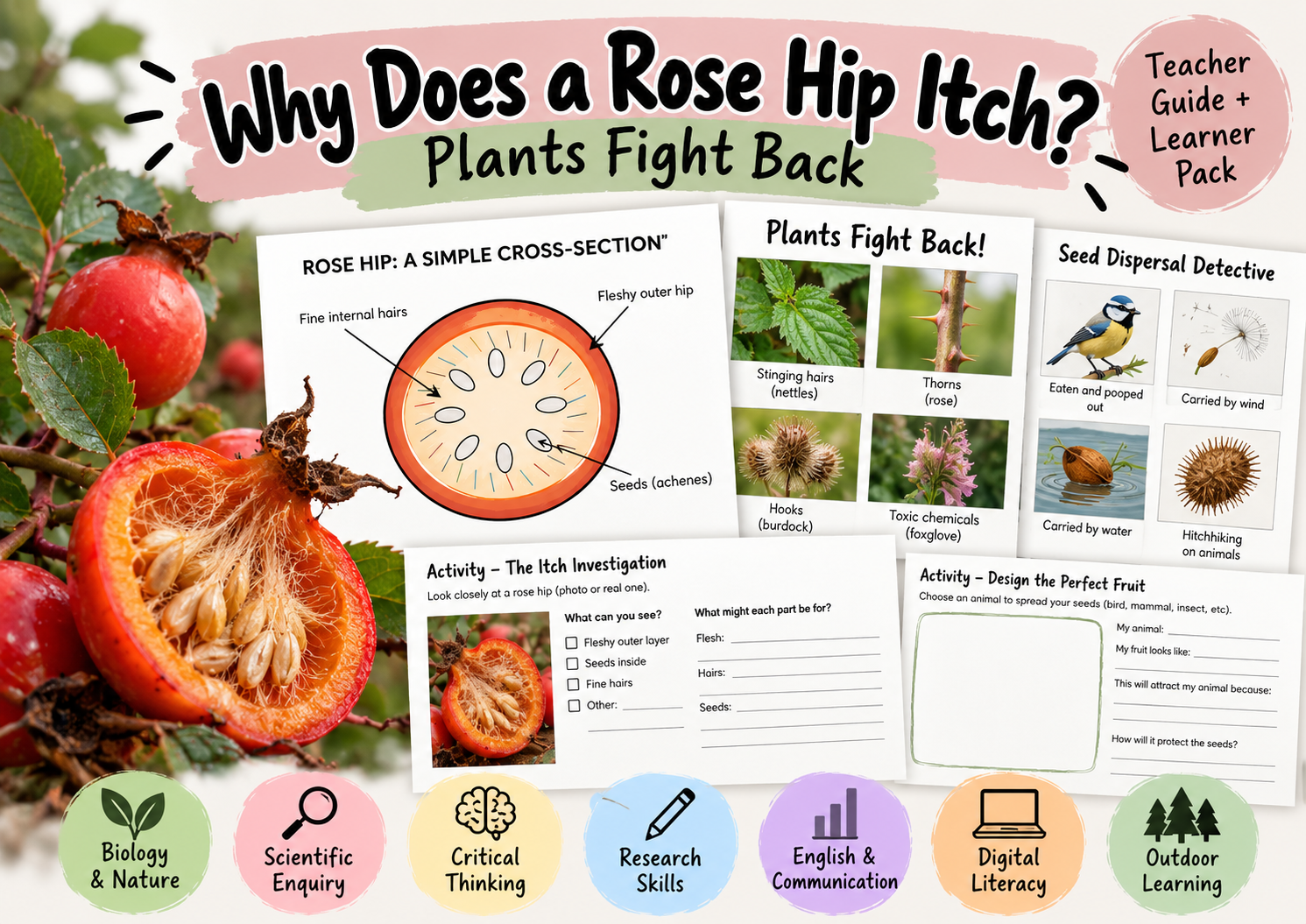
🌹 Why Does a Rose Hip Itch? – Plants Fight Back!
Teacher Guide + Flexible Learner Pack
Plants can't run away. They can't hide. And they definitely can't shout “STOP EATING ME!” 😂🌿
So how do they defend themselves?
And here's the bigger mystery…
If plants actually benefit from animals eating their fruits and spreading their seeds, why do they also grow prickles, stinging hairs, irritating fibres, bitter chemicals and toxins designed to make animals back off?
Why Does a Rose Hip Itch? – Plants Fight Back! takes one wonderfully weird question and turns it into a much bigger investigation of plant biology, evolution, adaptation, seed dispersal and the relationships between plants and animals.
Rather than simply learning a list of plant defences, learners investigate why apparently contradictory adaptations can make perfect sense.
🌿 Inside the pack
The detailed Teacher Guide + Learner Pack includes:
- 🌹 Rose hip investigation and labelled cross-section
- 🔬 Physical, chemical and indirect plant defences
- 🌵 Thorn, spine or prickle? botanical detective challenge
- 🌿 Stinging hairs, trichomes, prickles, bitter compounds and other defence strategies
- 🐦 Why plants sometimes want animals to eat their fruit
- 💩 The wonderfully unavoidable world of animal-poo seed dispersal
- 🌬️ Wind, water, animal, explosive and gravity-based seed dispersal
- 🧬 Natural selection and evolution — without making it sound as though plants consciously choose their adaptations
- 🧪 Safer Scientist Challenge: how can we investigate something irritating without testing it on ourselves?
- 📸 Outdoor Plant Defence Hunt
- 🐦 Who Gets to Eat Me? animal/plant relationship investigation
- 🌺 Design the Perfect Fruit challenge
- 🌱 Design a Plant That Fights Back
- 🕵️ Attraction vs defence sorting and reasoning
- 🧠 Fact, hypothesis or question? critical-thinking activities
- 🔎 Independent research rabbit holes
- 🎥 Videos, websites and further-learning resources
- 💬 Teacher prompts, possible answers, misconceptions and useful background knowledge
- 🎨 Multiple ways to demonstrate learning without relying solely on writing
- 🌟 Extension ideas for learners who want to go deeper
🧠 More than plant biology
This pack naturally crosses biology, ecology, evolution, scientific enquiry, critical thinking, research, English and communication, digital literacy and outdoor learning.
Learners are encouraged to ask questions such as:
Does every plant hair have the same purpose?
Why make fruit tasty if animals can damage the plant?
Does a bird eating something mean it's safe for a human?
Why doesn't every plant evolve the strongest possible defence?
Did a rose actually evolve prickles because animals were eating it — or is that just a story that sounds convincing?
That final distinction is important.
The pack encourages children to separate what they can observe, what they think might be happening, and what the evidence actually supports.
🔬 Safe, practical science
The activities deliberately encourage observation rather than unnecessary risk.
Learners explore how scientists can investigate stinging, irritating or defensive structures without deliberately rubbing them onto their bodies.
Because “let's see what happens if I cover myself in rose-hip itching hairs” might be enthusiastic science… but we can design a better experiment. 😂
🌳 Made for learning Sideways
There is no expectation that every page must be completed.
Learners can investigate outdoors, photograph discoveries, build models, draw, research independently, make slides, record videos or voice notes, discuss their ideas, complete worksheets or disappear down a completely unexpected botanical rabbit hole.
The pack actively encourages children to begin deciding:
What do I want to investigate?
What information am I missing?
Where could I find it?
Can I do this part independently?
What evidence would change my mind?
Because the aim isn't simply knowing that nettles sting or roses have prickles.
It's developing a learner who knows how to notice something strange and investigate it. 🌿🔎
Suggested age: approximately 9–14, with flexible activities suitable for adapting to different abilities, learning styles and levels of independence.
🔗 Digital + printable friendly: online resources are included as clickable hyperlinks, with the complete web address also written out for learners using a printed copy.
Sideways & Unboxed Learning — because sometimes the best lesson starts with: “Hang on… why does it do THAT?” 🌹🌿