

🦊 Foxes After Dark | Wildlife Ecology & Camera Investigation Home Education Resource Pack
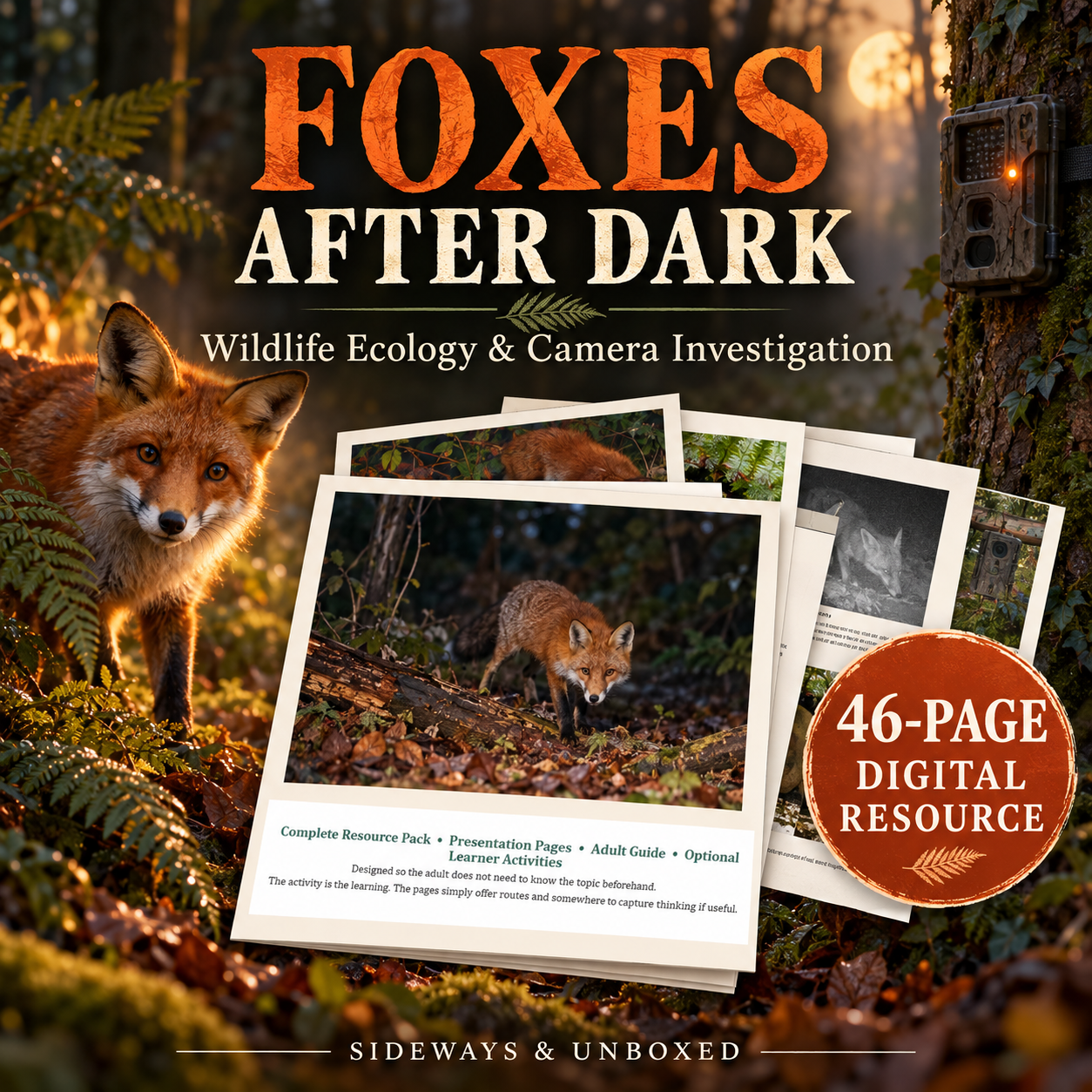
Habitats, food webs, evidence and responsible wildlife watching
What can a photograph of a fox actually tell us?
It proves that a fox was in that place at that moment. It does not automatically prove that the fox lives there, was hunting, visits every night or was alone.
Foxes After Dark uses an interest in foxes and wildlife cameras to explore science, geography, maths, English, media, ethics and critical thinking.
Designed around a Year 8/KS3 starting point, the activities can be adapted for different ages, abilities and learning styles. Learners can complete one activity, follow a particular line of interest or work through the entire project.
There is no requirement to complete every page—and no single “correct” way to record the learning.
What will learners explore?
The pack introduces:
-
What makes a suitable fox habitat
-
Shelter, food, water, routes and safe spaces
-
Physical and behavioural adaptations
-
How foxes survive in urban and rural environments
-
The varied diet of an adaptable omnivore
-
Food chains, food webs and energy transfer
-
Seasonal changes in food availability
-
Wildlife corridors, barriers and territory
-
Using cameras to investigate wildlife
-
The difference between evidence and inference
-
Recording, graphing and questioning data
-
Camera positioning, bias and missing information
-
Wildlife welfare, privacy and responsible observation
-
Humane ways to respond when foxes visit
-
Fact-checking wildlife claims
-
Creating field guides and short documentaries
The fox provides the interest. The investigation brings in the wider learning.
Presentation included
The document contains 11 landscape presentation pages which can be displayed on a computer, shown on a television, printed or used as conversation starters.
The presentation covers:
-
Foxes After Dark
-
What does a fox habitat need?
-
Adaptations for survival
-
Routes, barriers and wildlife corridors
-
The diet of an adaptable omnivore
-
Food chains and food webs
-
Urban and rural fox life
-
Camera evidence and inference
-
Keeping a camera-trap record
-
Responsible wildlife cameras
-
Living responsibly alongside foxes
There is no separate presentation to download—the slides and activities are kept together in one complete resource.
Adult guidance included
You do not need to be a wildlife expert or qualified teacher to use this pack.
The adult section includes:
-
A fox ecology knowledge bank
-
Suggested conversation prompts
-
Explanations and possible answers
-
Common misconceptions to look out for
-
Ideas for adapting the activities
-
Welfare, safety and privacy guidance
-
Questions for taking an investigation further
-
Trusted UK information sources
“I don’t know yet—let’s find out” is a completely valid place to begin.
20 optional learner activities
Choose whichever activities suit the learner’s interests:
-
Audit a fox habitat
-
Map a night-time fox route
-
Match adaptations to their jobs
-
Create a fox adaptation profile
-
Sort the fox diet
-
Plan four seasonal fox menus
-
Repair food-chain arrows
-
Change one part of a food web
-
Compare urban and rural fox life
-
Plan a responsible camera position
-
Separate evidence from inference
-
Keep a camera-trap log
-
Graph the night-time records
-
Challenge a claim made from data
-
Choose a humane response
-
Hold a wildlife ethics debate
-
Make a fox field-guide page
-
Create a one-minute fox documentary
-
Fact-check a fox claim
-
Complete the fox ecology knowledge check
A wildlife camera is not required. Learners can use supplied scenarios, existing photographs or clips, reference images, their own observations or an imagined investigation site.
Choose the level of challenge
Activities include different ways to take the subject further:
-
Explore – begin with the main idea
-
Investigate – examine the evidence more closely
-
Go deeper – question assumptions, connect ideas or complete a more demanding challenge
Learners can stop when they have done enough or continue when a question catches their attention.
Choose how to respond
Learning does not have to mean filling in a worksheet.
Depending on the activity, learners can:
-
Talk through their ideas
-
Draw or create a diagram
-
Write on the activity page
-
Use a whiteboard
-
Work on a computer
-
Take photographs or record a video
-
Build a model
-
Give a short presentation
-
Debate a decision
-
Teach someone else what they discovered
These options make the pack suitable for learners who prefer practical, visual, spoken or digital work.
Cross-curricular learning
One interest in foxes can lead naturally into:
-
Science – habitats, adaptation, diet, ecosystems and food webs
-
Geography – land use, urban environments, routes and wildlife corridors
-
Maths – tables, frequencies, graphs and interpreting data
-
English – explanations, debates, research and documentary scripts
-
Digital literacy – camera planning, media evidence and responsible recording
-
Citizenship and ethics – animal welfare, shared spaces and humane choices
-
Critical thinking – separating observations, assumptions and conclusions
What you will receive
✔ One complete 46-page Microsoft Word document
✔ 11 landscape presentation pages
✔ Adult knowledge bank and teaching guidance
✔ Safety, welfare and privacy information
✔ Conversation starters and investigation prompts
✔ Guidance for all 20 activities
✔ 20 optional learner activity pages
✔ Explore, Investigate and Go Deeper challenges
✔ Multiple ways for learners to record their work
✔ Knowledge-check questions and suggested answers
✔ UK wildlife information sources for further research
This is a digital download. No physical item will be posted.
Print only the pages you need, display them on a screen or work directly in the document.
Responsible wildlife learning
This resource encourages observation from a safe distance. Learners should never approach, corner, touch, trap, tame or hand-feed a fox.
Wildlife cameras should only be placed with permission, away from occupied dens and positioned carefully to protect other people’s privacy. Baiting wildlife is not required or recommended for any activity in this pack.
If a fox appears injured or seriously unwell, keep your distance and seek advice from an appropriate wildlife rescue organisation or veterinary professional.
Follow the question sideways
Sometimes the learning begins with a fox appearing on camera at 1:47 in the morning and one simple question:
“What does this actually prove?”
Notice something. Record the evidence. Question the first explanation. Think about what the camera may have missed. Then follow the next question.
That is learning sideways.