

🌿 What’s Hiding in a Leaf?
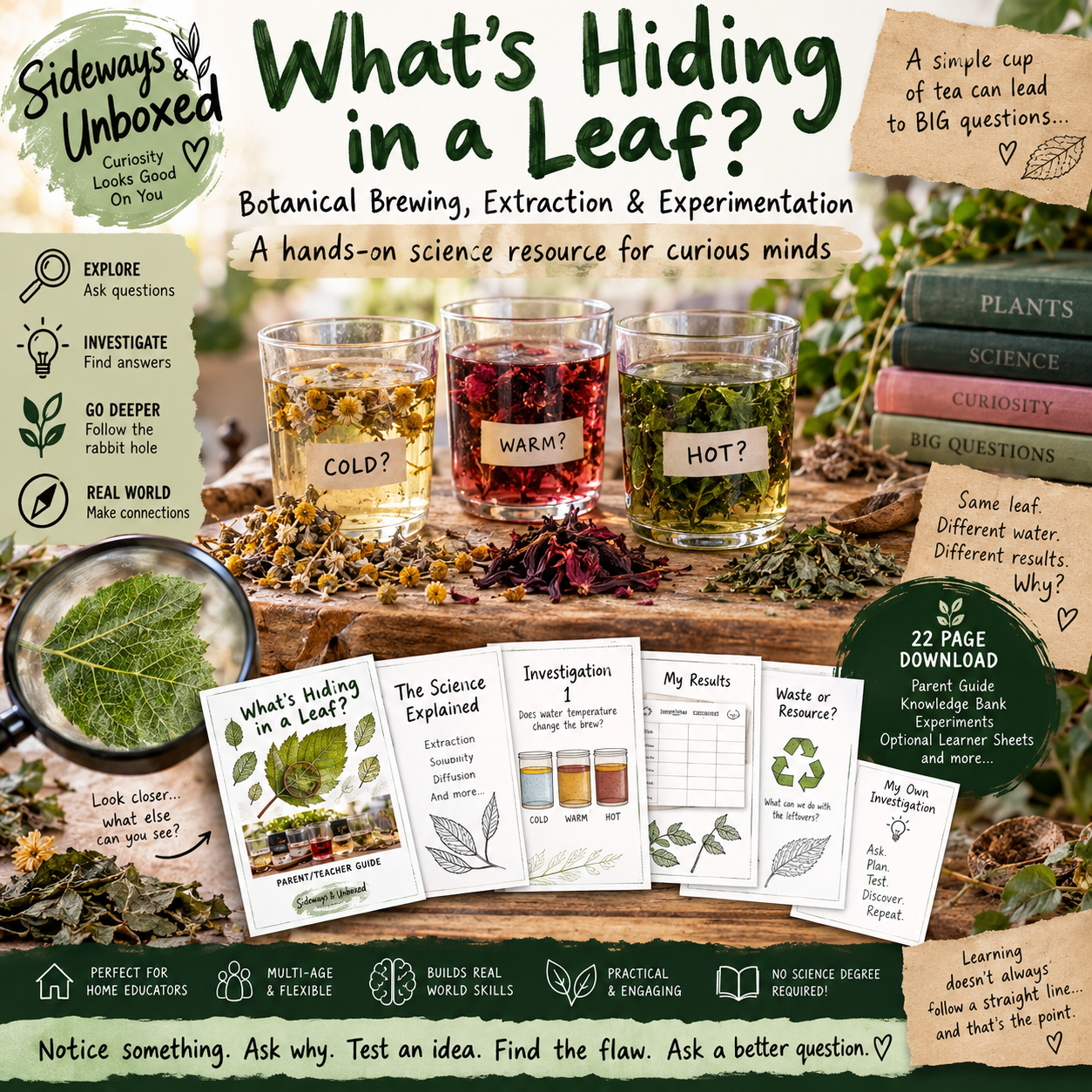
🌿 What’s Hiding in a Leaf?
Botanical Brewing, Extraction & Experimentation – Home Education Resource Pack
What actually happens when you put a dried leaf into water?
It sounds like a simple question.
But follow it sideways and suddenly you’re exploring chemistry, botany, maths, scientific investigation, sustainability, critical thinking, history and even product design.
What’s Hiding in a Leaf? is a curiosity-led practical science resource that uses botanical brewing to explore how substances move from plant material into water – and, more importantly, teaches children how to question, predict, test, observe and challenge their own conclusions.
This isn’t a pack designed around sitting down and completing pages of worksheets.
The experiment is the learning.
The included learner sheets are completely optional and can be replaced with discussion, photographs, drawings, videos, verbal answers or whatever works best for your learner.
🫖 What Will We Actually Do?
Start with a simple botanical infusion using an ordinary food-grade dried herb or herbal tea.
Then investigate questions such as:
-
Does water temperature change what happens?
-
Does brewing for longer make a difference?
-
What happens if we crush the leaves first?
-
Does stirring matter?
-
Where does the colour come from?
-
Why doesn't the whole leaf dissolve?
-
What's actually left behind after brewing?
-
Does darker automatically mean "more"?
-
How can we make an experiment fair?
-
How do we know whether our conclusion is actually supported by our evidence?
Learners begin by following a simple investigation before progressing towards designing their own experiment.
And if one question leads to another?
Perfect.
That's exactly the point.
👩🏫 A Proper Parent/Teacher Guide Is Included
You do not need to know the science beforehand.
A major part of this pack is the detailed Parent/Teacher Guide, designed to give you enough knowledge and prompts to confidently follow the conversation wherever your learner takes it.
Rather than simply giving you a list of questions to ask, the guide includes:
🌿 Background science explained in normal language
💬 Suggested questions and conversation starters
🧠 Possible learner answers
➡️ Ideas for where to take their answer next
❓ Common misconceptions to explore
🔬 Deeper scientific explanations when they're ready
💡 Follow-up questions
🧪 Experimental design guidance
⚠️ Practical and safety information
🌐 Suggested resources for further exploration
You don't need to lecture.
You have the information there when you need it.
🔬 Four Core Investigations
The pack gradually moves from guided exploration towards independent scientific thinking:
1. Does Water Temperature Change the Brew?
Compare cold, warm and hot water while observing what changes.
2. Change ONE Thing
Choose a variable such as brewing time, crushing, stirring or the amount of botanical material and begin learning about fair testing.
3. Become the Scientist
Create your own question, prediction and method before analysing the results and limitations.
4. Where Did Everything Go?
Weigh the botanical material before brewing, after brewing and after drying to explore mass, water, extraction, measurement error and what remains behind.
Then comes another question:
Is the leftover plant material actually waste?
That opens an entirely new investigation into sustainability, composting, reuse and by-products.
🐇 Follow the Rabbit Hole
The activity can stop after the first experiment – or one cup of botanical tea can take you into:
🌱 Botany – plant parts and their functions
🧪 Chemistry – solvents, solubility, extraction and diffusion
📊 Maths – mass, volume, temperature, ratios, tables and graphs
📚 English – predictions, explanations, methods and conclusions
📜 History & Culture – why humans have infused plants throughout history
♻️ Sustainability – waste, reuse and manufacturing by-products
🧠 Critical Thinking – does "natural" automatically mean safe?
💷 Business & Design – create a botanical product, calculate costs and challenge its marketing claims
Follow whichever paths interest your learner and leave the others for another day.
🌱 One Resource – Different Levels
There is no fixed school year attached to this pack.
Instead, activities can be adapted to your learner.
🌱 Explore
Observe, smell, measure, draw, predict and talk about what's happening.
🌿 Investigate
Introduce fair testing, ratios, measurements, tables, graphs and evidence-based conclusions.
🔬 Go Deeper
Explore scientific terminology, variables, diffusion, experimental limitations and independent investigation design.
This makes the resource particularly useful for mixed-age families, home educators and neurodivergent learners who don't fit neatly into a single worksheet level.
📄 Optional Printable Learner Sheets Included
The pack includes printable pages for:
-
My Prediction
-
What I Notice
-
Fair Test Planner
-
Results Table
-
My Conclusion
-
Waste or Resource?
-
Botanical Detective
Use all of them.
Use one.
Or use none.
Your learner can record their work through writing, drawing, photographs, discussion, audio, video or another method that works for them.
The recording method should support the learning – not become the barrier to it.
📦 What You Receive
A 22-page downloadable resource pack containing:
✔ Detailed Parent/Teacher Guide
✔ Parent Knowledge Bank
✔ Safety guidance
✔ Equipment and preparation guide
✔ Guided botanical brewing experiment
✔ Detailed discussion prompts
✔ Possible answers and explanations
✔ Fair-testing guidance
✔ Independent investigation challenge
✔ Sustainability and reuse investigation
✔ Cross-curricular extension ideas
✔ Parent Q&A
✔ Seven optional learner sheets
✔ Recommended resources for further learning
Digital download – no physical product will be posted.
🌿 Sideways & Unboxed
Learning doesn't always need to begin with a subject, worksheet or predetermined answer.
Sometimes it starts with something as ordinary as dropping a leaf into water and asking:
"What's actually happening in there?"
Notice something.
Ask why.
Test an idea.
Find the flaw.
Ask a better question.
That's the learning.